
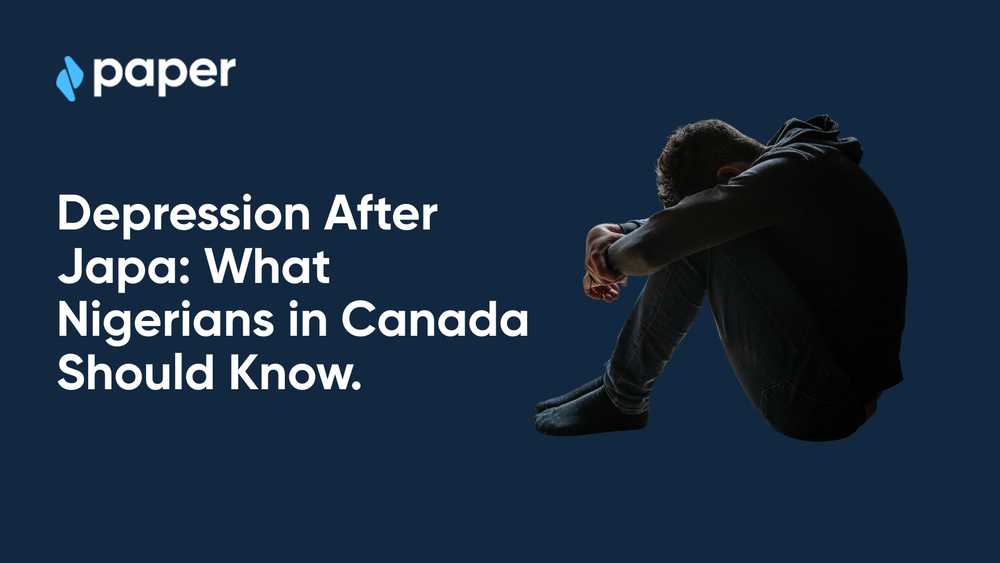
Emotional and Mental Health Realities of Relocating to Canada as a Nigerian (And How to Cope).
Nobody warns you about the crying.
This is not necessarily the airport or the goodbye-at-departures kind, because at least, you expect that one.
The crying that catches you off guard is the quiet kind. Being alone in your apartment on a Tuesday evening in February, the sky dark by 4:30pm, the street outside impossibly still, wondering why everything feels so heavy when everything is technically going well.
This is the part of the Japa journey nobody posts about.
A study published in the Journal of Immigrant and Minority Health found that over 51% of Nigerian immigrants surveyed in Canada screened positive for depression. More than one in two people. This article is an honest conversation about why that happens, and what you can actually do about it.

The Expectation vs Reality Gap
Most Nigerians who relocate have a plan. By the time you land, you've invested so much emotionally, financially, mentally — that there's a quiet assumption the hard part is over.
It isn't.
The hard part begins three months in.
The job might take longer than expected. People are polite but not warm. The community you imagined takes time to find, and the version of yourself you thought you'd be by now hasn't shown up yet.
For Nigerians, there's an extra layer. The cultural pressure to project success, especially to family back home. When your mum calls every Sunday asking "how is Canada?", saying "I'm not okay" can feel like a betrayal of everything the move was supposed to mean.
So people smile through it, and the weight quietly builds.
This gap between expectation and reality is one of the most common, and least talked about causes of emotional distress among Nigerian newcomers. It isn't a failure but just what adjustment actually feels like.
The Winter Nobody Told You About
If you've never experienced a Canadian winter, no description fully prepares you.
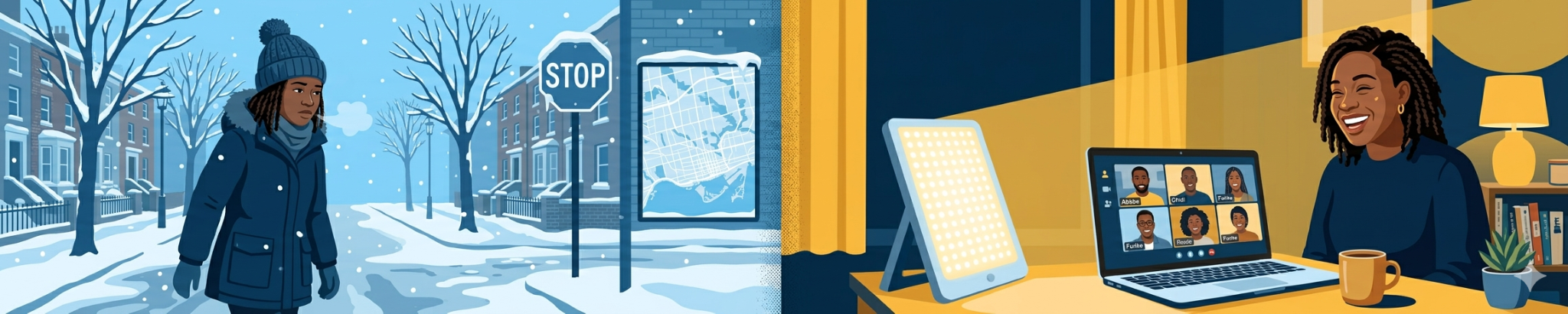
By November, the days start shortening sharply. By December, the sun sets before 4:30pm in most major cities. By January and February, you may go entire weeks seeing nothing but grey sky and white ground. The cold keeps you indoors, reduces spontaneous social contact, and strips the environment of colour and activity that usually buffer loneliness.
Data from Mental Health Research Canada shows rates of depression rise by three percent in January. For newcomers, it's specifically during fall and winter that mental health struggles peak.
- You're indoors more than you've ever been.
- The sun disappears before 5pm. Family is worlds away.
- The stress of settling doesn't pause for any of it.
That combination does something real to your mood, and it has a name.
Seasonal Affective Disorder (SAD) is a form of depression triggered by reduced sunlight in fall and winter — disrupting your sleep, lowering your energy, and affecting your mood in ways that feel bigger than "just the cold."
About 15% of Canadians experience it, according to the Canadian Psychological Association. For someone arriving from Nigeria's year-round sun, it hits harder.
What actually helps:
- Light therapy lamps — research strongly supports bright light therapy as a first-line treatment. A light box with at least 10,000-lux intensity used for 30 minutes daily consistently improves mood during dark months. Available for $30–$80 on Amazon Canada. It sounds too simple. It genuinely works.
- Getting outside during daylight hours — even a 20-minute walk when the sun is up makes a real neurological difference
- Vitamin D supplements — widely recommended in northern climates, especially for those coming from sunnier countries
- Plan for winter before it hits — buy proper winter clothing in October, identify indoor activities and social commitments before isolation sets in. The Nigerians who manage winter best treat it as something to prepare for, not just endure.
The Identity Shift Nobody Warns You About
Back home, you had context. Your accent was normal, and your humour landed. You knew the unspoken rules like when to push, when to defer, who commands respect and how it's given. You had social position, relationships with depth, and a version of yourself that felt coherent.
In Canada, much of that gets scrambled.
Your accent suddenly stands out. The way Canadians interact…polite, measured, rarely going beyond surface-level can feel cold to someone who grew up where people are loud, warm, and in each other's business by default.
You start code-switching more than you expected, and at some point, many Nigerians describe the same unsettling question quietly surfacing: Who am I here?
This is a transition but it can feel like crisis, especially when nothing external has stabilised yet either.
What helps:
- Stay connected to your community — deliberately. The Nigerian community in Canada is large, active, and genuinely supportive. It exists across cities in churches, professional networks, social groups, WhatsApp communities. Being around people who share your background and get your references isn't a retreat from integration. It's the emotional sustenance that makes integration sustainable.
- Don't perform well for home. The gap between what you post and what you feel creates its own kind of loneliness. Find at least one or two people here or back home — with whom you can be honest about how the transition is actually going.
- Let your Nigerian identity be an asset. The warmth, the resilience, the communal instinct, these are things Canada often lacks. Don't file them away to fit in. Bring them.
The Loneliness That Surprises People
Canada is friendly, and yet loneliness is one of the most commonly reported experiences among Nigerian newcomers. The social culture simply operates differently.
Back home, relationships are immediate and layered. In Canada, friendships develop slowly and deliberately.
People are warm on the surface but don't quickly go deep. For Nigerians accustomed to communal living, this quietness can feel lonely even when you're surrounded by people.
What helps:
- Hobbies with recurring social contact — a gym class, a football league, a church. Not a one-off event but somewhere you see the same people repeatedly. That's how Canadian friendships form.
- The Nigerian diaspora network — join associations, LinkedIn groups, and WhatsApp communities in your city.
- Scheduled social time — in Nigeria, community was ambient. In Canada, it requires intention.

The Pressure from Home That Doesn't Let Up
When you move to Canada, you don't just move. In the minds of many families back home, you become a pipeline. The financial asks come. Expectations expand, and saying "I'm also finding my feet" can feel like a betrayal of the sacrifice that got you here.
You cannot pour from an empty cup. Burning yourself out financially or emotionally in the first two years trying to be the family solution may leave you unable to help anyone — including yourself.
Stability first is not selfishness. So set expectations early. Have an honest conversation about what you can send and on what timeline.
Budget remittances at a level you can sustain every single month — not what feels generous in month one.
When It Becomes More Than Adjustment
If low mood, anxiety, or hopelessness has persisted for more than two weeks, is affecting your ability to function, or is accompanied by thoughts of self-harm — please reach out.
The 988 Suicide Crisis Helpline is available across Canada — call or text 988 anytime. Free, confidential, available to everyone regardless of immigration status.
- 211 — connects you to local mental health services in your area
- CAMH (camh.ca) — resources including immigrant-specific programmes
- Settlement agencies across Canada offer free counselling for newcomers — search for your local ACCES Employment, Newcomer Centre, or YMCA
Many therapists offer sliding-scale fees based on income. Employer health plans often cover counselling too.
Getting help is not a sign that you've failed your move. It's a sign that you take your wellbeing as seriously as your career and your finances.

Staying Connected to Home Changes Everything
Sending money home regularly is one of the most meaningful ways diaspora Nigerians stay tethered to family.
It communicates: I haven't forgotten you. I'm still part of this. But that process should never add stress to an already stretched season.
That's exactly where Paper comes in.
Paper is built for Nigerians in Canada who are holding two worlds at once, and need the financial side of that to be seamless.
✅ Best exchange rates — no quiet markups eating into what your family receives.
✅ Zero transfer fees — every naira they're expecting actually arrives.
✅ Fast transfers — because waiting isn't always an option.
✅ Canadian bill payments — manage your life here from the same app.
✅ Airtime top-ups — keep your parent’s phone on from anywhere.
✅ School fees payments — directly from Canada to Nigerian institutions via the app.
You're doing and carrying enough. Let Paper handle the cross-border financial piece so you can put your energy into building, healing, and actually thriving here.
👉 Download Paper and start sending smarter
Take care of your mind the same way you're taking care of your money. You came too far for anything less.
Frequently Asked Questions
Q: Is it normal to feel depressed after moving to Canada? Yes, and more common than most people admit. Research found that over 51% of Nigerian immigrants surveyed in Canada screened positive for depression. Adjustment difficulty is normal in the first 1–2 years. What matters is recognising it early.
Q: What is Seasonal Affective Disorder and do I need to worry about it? SAD is seasonal depression triggered by reduced sunlight in autumn and winter. If you're arriving from Nigeria, your body is not accustomed to Canada's dark winters. A light therapy lamp, Vitamin D, staying active, and community are the first lines of defence. If symptoms persist, speak to a doctor.
Q: How do I find Nigerian community in Canada? Search for Nigerian associations in your city, join Nigerian professional groups on LinkedIn, and ask in Facebook and WhatsApp communities for Nigerians in your province. Nigerian churches are also significant community hubs in most major Canadian cities.
Q: What free mental health support exists for newcomers? Call or text 988 for the national crisis helpline, available 24/7. Dial 211 to connect to local mental health services. All services are free, confidential, and available regardless of immigration status.
Q: How do I manage financial pressure from home without breaking myself? Set a fixed, sustainable monthly amount from day one — not based on what's asked, but on what your budget can genuinely absorb. Use Paper so every transfer arrives in full, with the best rates and zero fees.
Your pen pal, Paper ✍🏽